A change in the weather can make itself known in my hip.
The pain arrives, and suddenly the weather is more than something happening outside my window. It becomes part of how I move, how comfortable I feel and what the day asks of me.
I notice it in my head too. Around changes in atmospheric pressure, there is a pressure sensation that is difficult to explain to someone who has never experienced it. I associate it with the weather, although I cannot tell you exactly what causes it.
Living with the late effects of polio means learning to notice these things. Our bodies have their own history, and sometimes an ordinary change in temperature becomes a very personal experience.
A conversation with Susan Schoenbeck inspired me to write about this: what I notice, how I respond and what I do to look after myself.
My routine includes supplements, warmth, weekly physiotherapy and gentle movement. None of this is a universal recipe. It is a glimpse into my everyday life, alongside what research can—and cannot—tell us.
What I feel, and what science can explain
There is something reassuring about discovering that an experience has been studied. Especially when other people sometimes dismiss it.
Cold sensitivity after polio has a scientific basis. In a small study published in 1985, Richard Bruno and colleagues examined five polio survivors and age-matched controls at different room temperatures. They measured skin temperature, blood flow and nerve conduction.
Their findings suggested that altered control of blood vessels could contribute to heat loss, with cooling affecting nerve and muscle function. Five participants cannot represent every survivor, but the study offers a possible explanation for why relatively mild cold may become uncomfortable. Bruno and colleagues, Orthopedics, 1985
The question of atmospheric pressure and pain is less settled.
A 2023 review found associations between weather conditions and osteoarthritis pain. A 2024 review using a different study approach found no consistent associations for several musculoskeletal conditions. Neither establishes what causes my hip pain or the sensation in my head, and neither specifically explains weather sensitivity in post-polio. Wang and colleagues, 2023, Ferreira and colleagues, 2024
I can describe the pattern I experience without claiming that the mechanism has been proven. That leaves room for both personal experience and scientific honesty.
My approach to nutrition and supplements
One part of my routine is paying attention to nutrition. I use supplements made from dried fruit, vegetables and berry juice, either in capsules or as powders mixed into a drink.
I also take magnesium, glycine and collagen.
My intention is to look after my nutritional intake and, within that, the needs of my immune system. These products are additions to everyday nourishment. They do not replace meals, and I do not regard them as treatments for post-polio or weather sensitivity.
What interests me is how a routine fits into real life. Something may be easy to discuss in theory and much harder to manage on a tiring day. Convenience matters when shopping, preparing food and clearing up all require energy.
But convenience does not tell us what a product does.
A capsule containing fruit or vegetable ingredients should not be assumed to provide everything the original food provides. Formulations differ, so I think the contents deserve more attention than the attractive pictures on the packaging.
For me, the important question is whether an addition has a clear nutritional purpose.
What I notice when people around me catch colds
There is another personal observation I want to share.
When people around me have colds, I often remain largely spared from becoming seriously unwell myself. Naturally, I am grateful for that.
It would be easy to place that observation beside my supplement routine and draw a straight line between the two. I cannot honestly do that. My experience does not show whether supplements contributed, and it cannot predict what another person would experience.
Exposure, previous infections, vaccination and other circumstances can differ considerably.
The National Institutes of Health explains that adequate amounts of certain vitamins and minerals are important for normal immune function. Supplements can help increase intake when a nutrient is lacking. However, in people without a deficiency, routine supplementation generally does little to prevent or treat specific infections. NIH Office of Dietary Supplements: Immune Function
Looking after nutritional needs has a place in everyday care. Claiming protection from illness requires evidence that my personal story cannot provide.
I can share what I take and what I notice. I cannot offer anyone a guarantee.
Magnesium, glycine and collagen in perspective
These three supplements are part of my routine, but they deserve separate consideration.
Magnesium is an essential mineral involved in many processes, including normal muscle and nerve function. That physiological role does not establish that additional magnesium relieves post-polio symptoms or weather-related hip pain. Existing intake, individual needs and possible medication interactions matter. NIH: Magnesium
Glycine is an amino acid. A 2023 systematic review examined its effects in adult humans across several areas. Some small sleep studies reported favourable findings, but the reviewers highlighted small sample sizes and a high risk of bias. This is not evidence of a treatment for post-polio or temperature sensitivity. Systematic review of glycine administration, 2023
Collagen has been studied in joint conditions, including knee osteoarthritis. A 2025 meta-analysis reported improvements in pain and function, with substantial variation between studies. Those findings cannot simply be transferred to post-polio, to my hip or to the particular product I use. Simental-Mendía and colleagues, 2025
Sharing a routine also means being clear about its limits. Supplements deserve thoughtful questions, including whether they are appropriate alongside existing medicines and health conditions.
Warmth now, and perhaps a different home one day
I am seriously considering moving to southern Europe in a few years. I would like to find somewhere with a warmer, more settled climate and milder winters.
The thought has become part of how I imagine my future: living somewhere that might make the colder months more comfortable. I know southern Europe has its own seasons, cold spells and summer heat. A move would take careful consideration, and I cannot know in advance how my body would respond.
Until then, I find warmth closer to home.
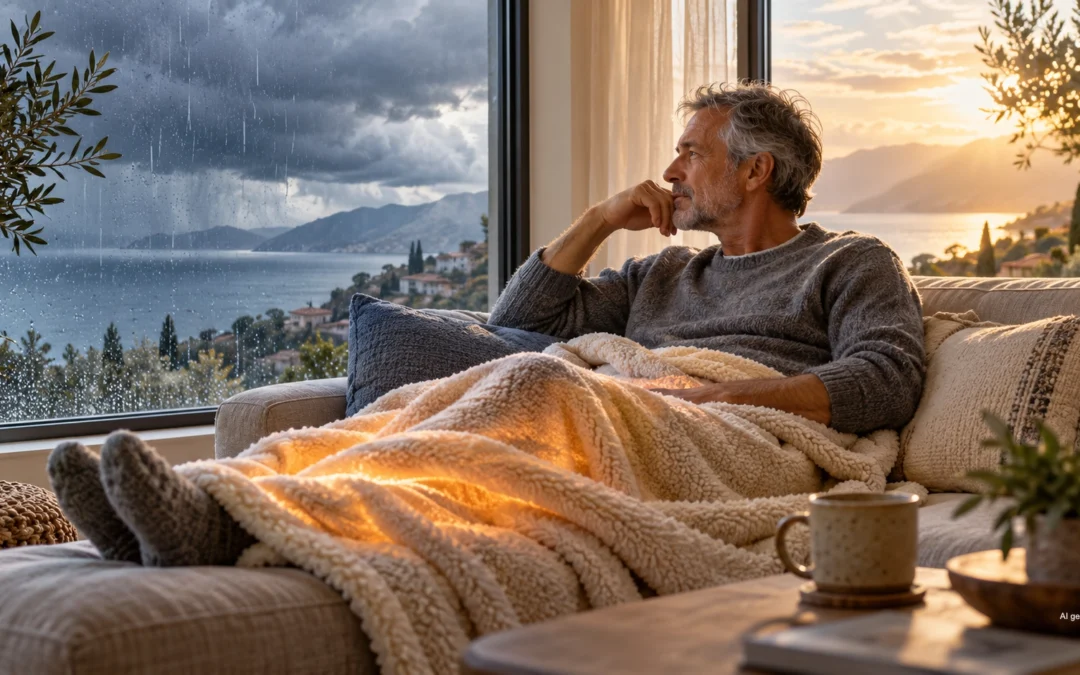
On colder days, I spend my evenings on the sofa with an electric heated blanket, warming my feet, legs and the area up to my hip. Merino wool thermal underwear is another part of my routine, an extra layer I appreciate when the temperature drops.
These ordinary details belong in the story of living with post-polio. Sometimes looking after ourselves means choosing what to wear, finding a comfortable place to rest and allowing ourselves that time.
For me, the blanket and warm clothing are personal comforts. They are not ways to repair nerves or change the course of post-polio.
For anyone using electric warmth, following the device instructions matters. Reduced sensation or circulation calls for individual advice, because heat can cause burns when it cannot be reliably felt. NHS physiotherapy guidance on heat and cold
Perhaps, in a few years, my winter evenings will look different. For now, there is my sofa, my merino layers and the welcome warmth of my blanket.
Why weekly physiotherapy matters to me
A weekly appointment with my physiotherapist is a must for me.
Having that regular contact gives this part of my life a place in the calendar. Movement and physical difficulties do not have to wait until everything becomes more demanding.
My weekly rhythm is personal. It is not a recommendation that every survivor needs the same frequency or programme.
A major review of post-polio syndrome describes individualised rehabilitation and energy conservation as central approaches to management. It also emphasises the complexity of fatigue and the limited understanding of many aspects of the condition. Li Hi Shing and colleagues, 2019
Our starting points differ, so our plans should differ too. An exercise that is manageable for one person may ask too much of another. Professional guidance needs to make room for the person doing the movement.
A little yoga, chair yoga and swimming
Alongside physiotherapy, I do a few small yoga exercises, gentle chair yoga or go swimming. These are ways I try to preserve flexibility and keep movement in my life.
Chair yoga belongs here because movement does not have to begin on a mat on the floor. An adaptation can make participation more practical.
Swimming is part of my routine too, although research on water exercise should be described accurately.
A small controlled study published in 2001 examined exercises in heated water for people with the late effects of polio. Participants reported less pain-related distress, but the programme did not improve all measured outcomes. It involved non-swimming exercises, so it does not prove that ordinary swimming has the same effects. Willén and colleagues, 2001
Exercise literature in post-polio also stresses avoiding activities that cause increasing muscle pain or excessive fatigue. Agre, 1995
Gentle movement still needs to fit the body doing it. There is no prize for doing more than that body can comfortably manage.
Sharing the ordinary parts of our lives
The conversation with Susan encouraged me to put these experiences into words.
There is my hip when the weather changes. The pressure sensation in my head. The supplements I choose, the blanket on the sofa and the weekly physiotherapy appointment. There are small movements that keep me engaged with my body, and thoughts about where I might live one day.
Together, they form part of how I care for myself.
I share them because our community needs room for practical experiences as well as scientific information. We can exchange ideas, ask questions and acknowledge uncertainty without dismissing what someone feels.
And we can make daily life a little more understandable to people who have never had to think about the temperature of their feet.
With love and sunshine,
Viney
These are my personal experiences, alongside general research information. They do not establish supplement benefits or replace individual medical, nutritional or physiotherapy advice. New or changing symptoms should be assessed rather than automatically attributed to the weather or previous polio.